
2026/05/18
What happens when you run white knit cutting clips through a MORINTE opening & cleaning line?
The answer is in the numbers – and they’re better than expected.
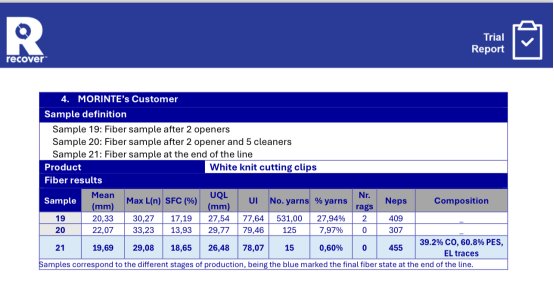
At a MORINTE customer site in Spain, we tracked every stage of the process. From the first opener to the final fiber state, the transformation is clear.
Meet the Samples
Sample | Stage |
19 | After 2 openers |
20 | After 2 openers + 5 cleaners |
21 | End of the line – ready for spinning |
Sample 21 is the star: final fiber, fully processed, blue-marked in the report.
The Makeover – What the Fiber Gained
Let’s compare Sample 19 vs Sample 20 (what a difference 5 cleaners make):
Metric | Before (S19) | After cleaning (S20) | Change |
Mean length | 20.33 mm | 22.07 mm | +8.6% |
Max length | 30.27 mm | 33.23 mm | +9.8% |
Short fibers (SFC) | 17.19% | 13.93% | –19% |
Neps | 409 | 307 | –25% |
Rags/impurities | 2 | 0 | ✅ gone |
The fiber got longer, cleaner, stronger – exactly what spinners dream of.
At the Finish Line (Sample 21)
Even after final processing, the fiber stays in great shape:
Mean length: 19.69 mm
Short fiber content: 18.65% – still better than raw start
UQL: 26.48 mm
Uniformity index: 78.07%
Impurities: 0
Final blend:
39.2% Cotton
60.8% Polyester
Traces of Elastane
Why This Matters
Recycling knit waste isn’t easy. Short fibers, neps, and impurities love to crash the party.
But with the MORINTE multi-stage lineup – openers + cleaners working in harmony – you get:
Longer fibers = stronger yarns
Fewer shorts = less waste, fewer breaks
Cleaner feed = better fabric surface
Consistent output = confidence in every batch
“This is real-world proof that our machines don’t just clean fiber – they unlock its hidden value.”
– MORINTE process team
The Bigger Picture
Every ton of white knit clips that runs through a MORINTE line becomes usable, spinnable, valuable fiber.
Less waste to landfill. More quality for your yarn. And a process you can actually trust.