


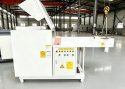
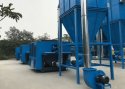
Textile Waste Cutting Machine for textile waste recycling, specifically designed for the pre-treatment of waste materials such as yarns, fabrics, and scraps in the textile industry. Its core function is to cut large or long sections of textile waste into small or short pieces, facilitating subsequent recycling and reuse.
Textile waste cutting machine breaks through the limitations of traditional equipment—low accuracy, frequent jamming, single-material capability, and complex upkeep. Built for stable, reliable operation, it delivers uniformly cut material with minimal waste. Perfectly suited for both high-end precision work and large-scale, cost-effective production.
Customizable upgrades available. Machine configurations can be tailored to your specific material characteristics and capacity needs. The ideal automated choice for fiber processing, waste recycling, and productivity enhancement across industries.
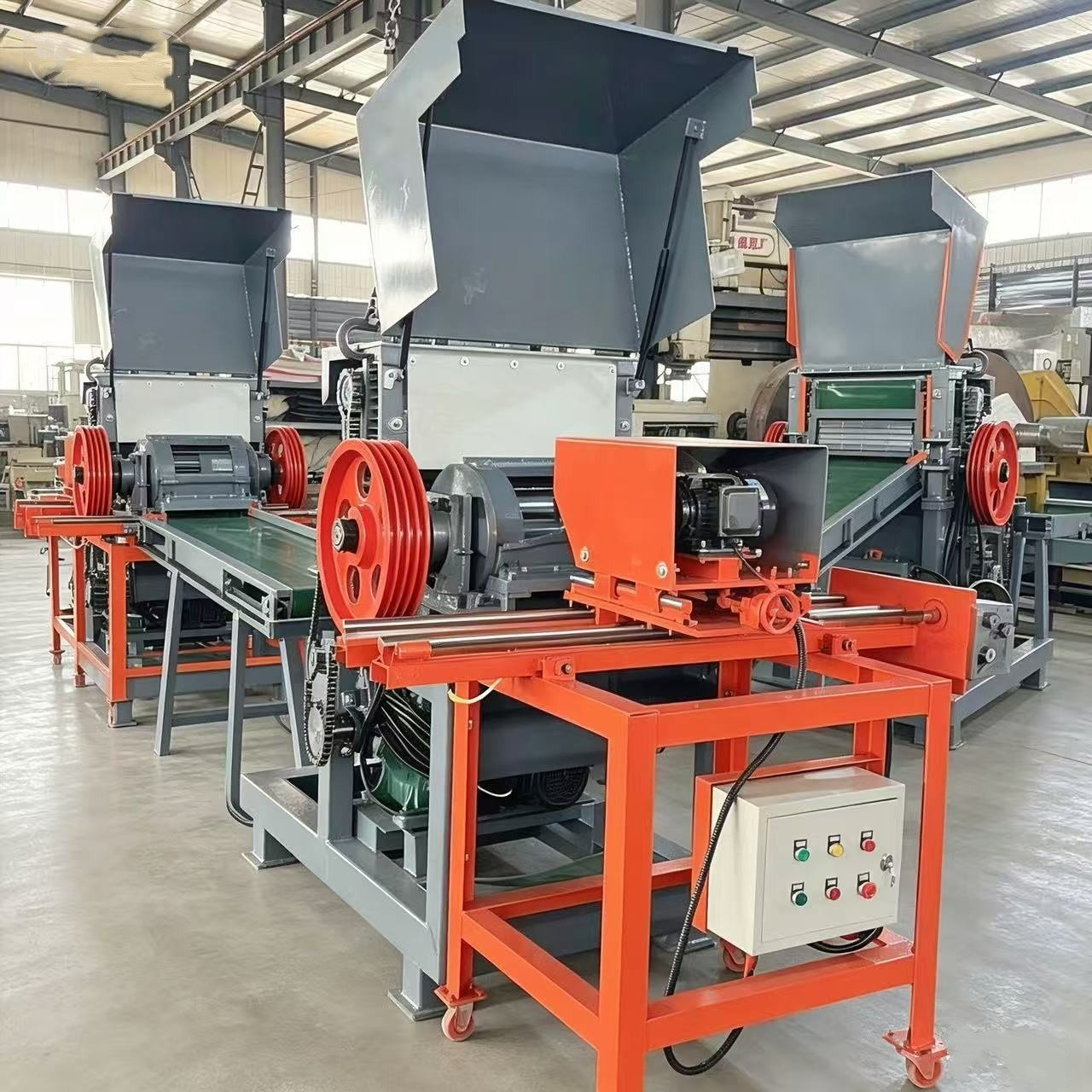
Model | 800MT | 1200MT | 1600MT | 2400MT |
Capacity | 500–800 kg/h | 800–1200 kg/h | 1000–3000 kg/h | 3000–4000 kg/h |
Main motor | 8P+7.5KW | 8P + 15 kW | 8P + 18.5 kW | 8P + 15 kW(Two sets) |
Conveyer motor | 4p1.5kw | 4p2.2kw(variable frequency motor) | 4p3.0kw(variable frequency motor) | 14p4.0kw(variable frequency motor) |
Belt wheel | Θ100 | Θ140 | Θ120 | Θ140 |
Moving blade base | Θ300 | Θ400*600 | Θ500*800 | Θ600*1200 |
Feeding conveyor | 1400*330 mm | 3000*520 mm | 3000*720 mm | 3000*1100 mm |
Machine size | 2100*1000*1100 | 1400*1450*1500 | 1550*1700*1550 | 2100*1900*1550 |
Cutting size | 2.5.8cm | tunable | tunable | tunable |
The textile waste cutting machine primarily operates on the rotary blade (rotary knife) principle, achieving efficient cutting through a continuous sequence of actions: "Conveying – Pressing – Shearing – Discharging".
The detailed core workflow is as follows:
1. Automatic Material Conveying
The materials to be processed, such as fabric scraps and waste yarns, are fed smoothly and continuously into the machine via a conveyor belt or feeding device.
2. Pressing and Flattening
Before entering the cutting zone, the materials are pressed and flattened by a set of pressure rollers. This effectively prevents material tangling and ensures uniform force distribution during cutting, resulting in clean, neat cuts.
3. Precision Fixed-Length Shearing – The most critical stage
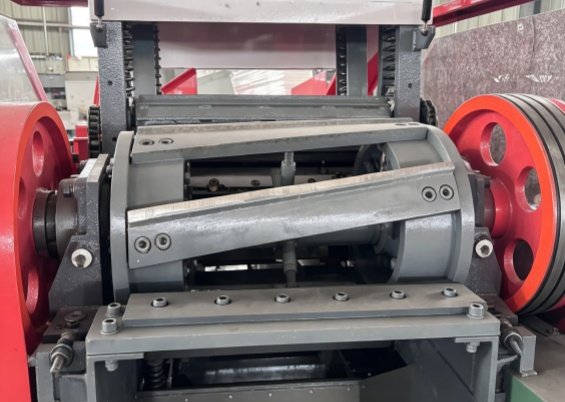
The equipment adopts a rotary blade (rotary knife) structure:
A high-speed rotating cutter head is equipped with multiple moving blades, while a stationary bottom blade is fixed below.
As the material is fed between the moving blades and the stationary blade, the rotating moving blades and the stationary blade form a continuous shear point, quickly cutting the material like a pair of scissors.
Length Adjustment:
The cut length is primarily determined by the material feed speed. The cut length can be easily adjusted by using a variable frequency drive (VFD) to control the conveyor belt speed – the slower the feed speed, the shorter the cut length.
4. Automatic Finished Product Discharge
The cut material falls onto a discharge conveyor belt or into a collection device, where it is automatically discharged, completing the entire processing cycle.
Space Requirements
Typical machine dimensions: Approx. 3000 × 1000 × 1100 mm (L × W × H)
Recommended clearance for operation and maintenance: At least 1 meter at the front and rear, and 0.5 meter on each side
Recommended installation area: Approx. 5–8 square meters
Power Requirements
Industrial-grade fiber cutting machines typically use 380V three-phase AC power
Motor configurations for different power models:
Standard model: Approx. 4–7.1 kW
High-output model: 13–25.5 kW
Pre-purchase confirmation: Please verify that your facility has 380V three-phase power access and that the power distribution capacity meets the equipment's power requirements
The cut length can be flexibly adjusted according to requirements. The general range is between 3–190 mm, while high-end models can achieve 5–360 mm.
Minimum adjustable length: Some models can achieve ultra-short fiber cutting down to 3 mm.
Adjustment method: Cut length is controlled by adjusting the conveyor belt feed speed via a variable frequency drive (VFD)—the faster the feed speed, the longer the cut length; the slower the feed speed, the shorter the cut length.
Length uniformity: Professional-grade models can ensure length tolerance of less than 0.2%, with no double-length or over-length fibers produced.
Our textile waste cutting machine can process a wide range of material types, such as fabric scraps, used clothing, cotton waste yarn, chemical fibers, fiberglass, linen, leather, paper, etc. Please inquire about whether the equipment is suitable for your specific materials.
The delivery time is 15-30 days.
Yes, hard ferrous objects can severely damage the blades, possibly causing blade fracture or even damaging the entire cutter head. However, protective equipment can be added.
Recommendation: If metal contaminants are common in your raw materials, opting for a strong magnetic separator is highly recommended
If you have any questions or needs about the product, please fill in the following form and we will contact you as soon as possible.